Why look up on Samothraki?
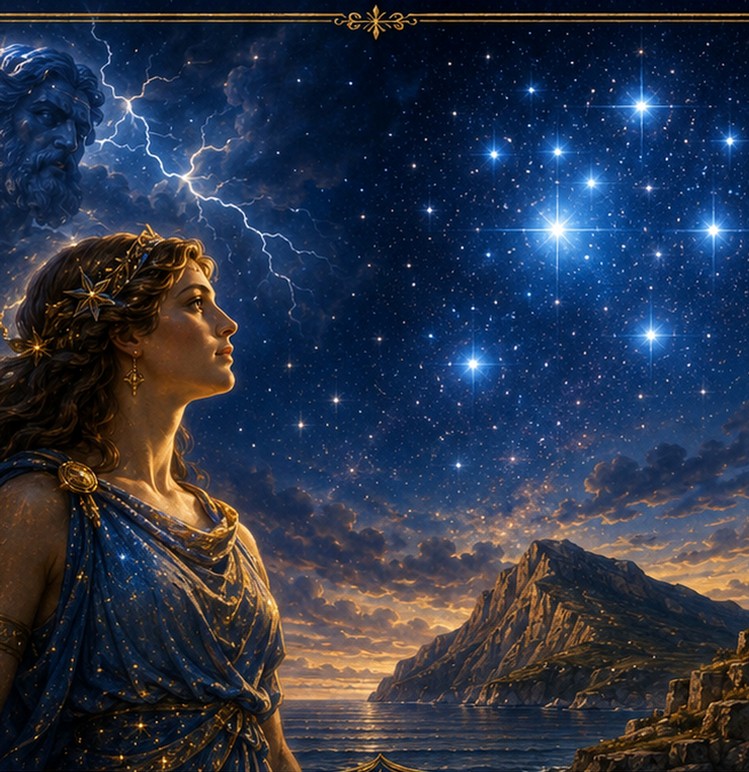
Anyone who has stayed on Samothraki past sunset knows the island does something unusual to the sky. With almost no light pollution and Mount Saos rising straight out of the sea, the stars here feel close enough to touch. It turns out this isn't just a modern traveller's impression — the ancients felt it too, and they wove an entire genealogy of gods, heroes and constellations around this small island in the north-eastern Aegean.
A recent study by geologist and educator Evangelos Markatselis, Astromythology of Samothrace, traces exactly this: how the island's landscape, its famous Mysteries, and the night sky above it were bound together in ancient memory. Here's a traveller's tour through the highlights.
The Pleiades and the island's celestial ancestor
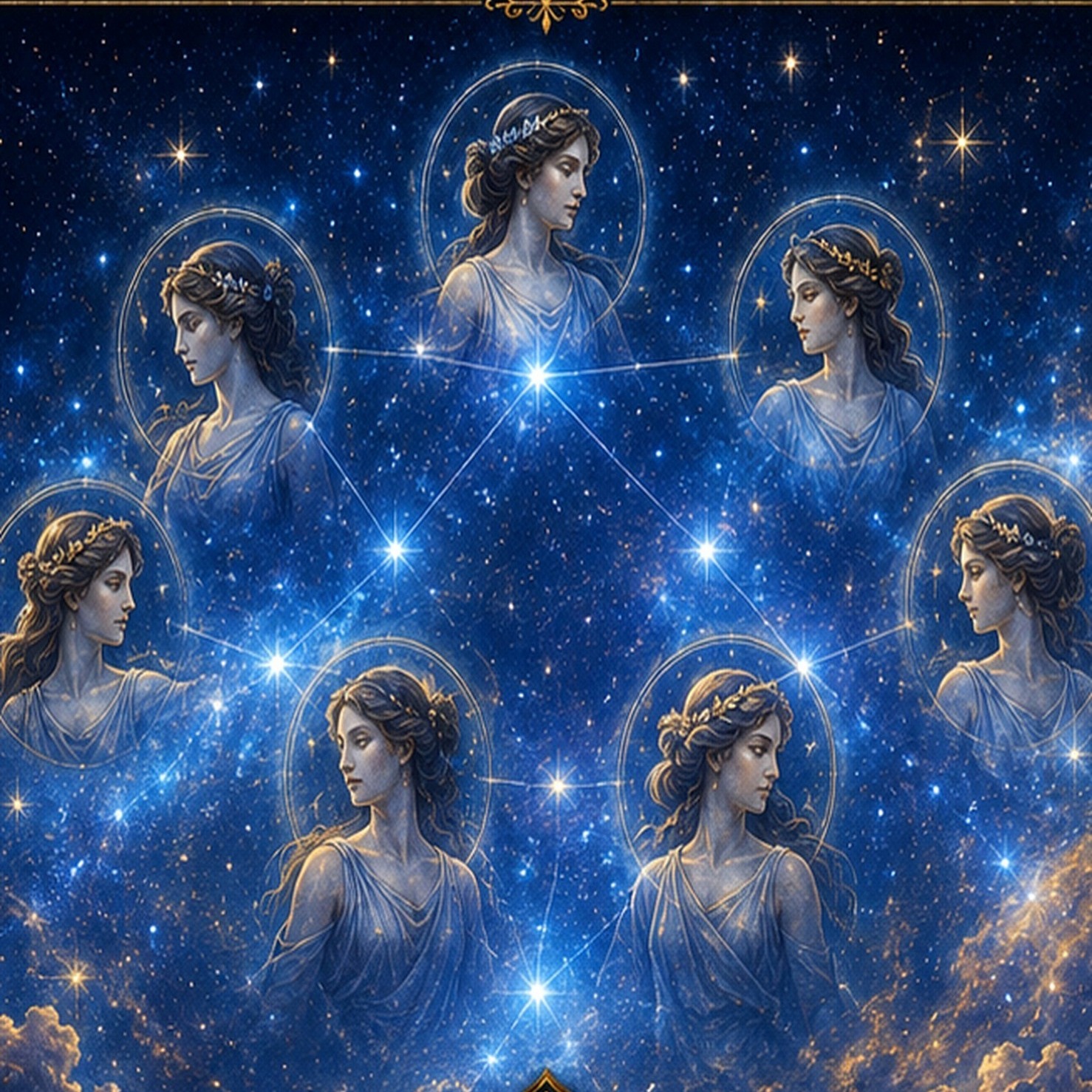
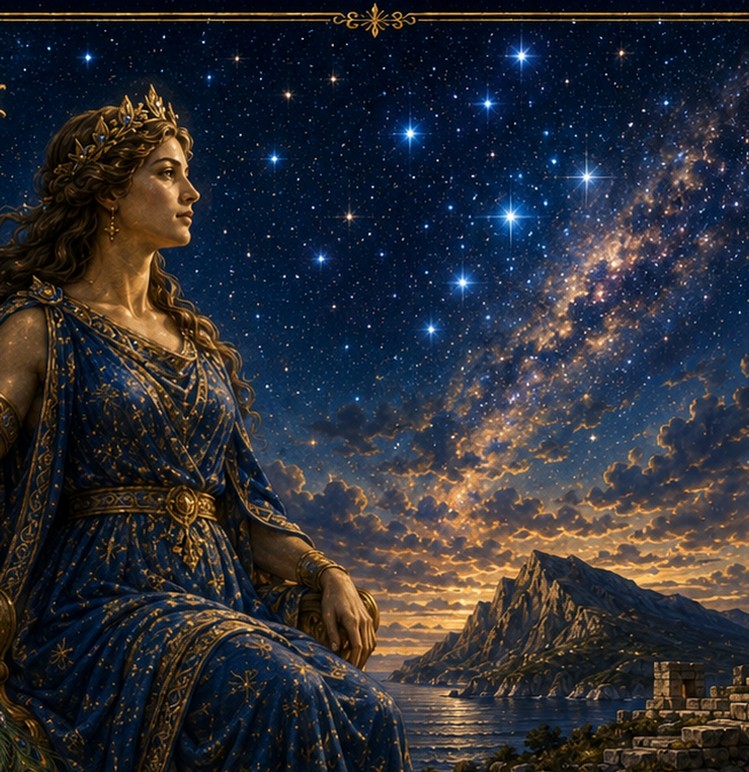
The story begins, as so much Greek myth does, with the Titan Atlas and the Oceanid Pleione, whose seven daughters — the Pleiades — became both a star cluster and a sprawling mythical family. Each sister carried her own thread of legend across the Greek world, but for Samothraki, one sister matters most: Electra.
In the version of the myth tied specifically to this island, Electra is the mother, by Zeus, of Dardanus and Iasion — and in some accounts, of Harmonia too. It's through Electra that the island's mythology plugs into the wider cosmos: she is the bridge between a cluster of stars still visible on a clear Samothraki night and the founding figures said to have walked its shores.
Dardanus, Iasion, and two very different legacies
The brothers born of Electra and Zeus represent two sides of the same coin. Dardanus leaves the island altogether, crossing to the Troad on the Asia Minor coast, where he founds the line that would eventually lead to Troy itself — migration and dynasty carried outward from Samothraki.
Iasion, by contrast, stays rooted in the island's identity as a place of initiation. Ancient sources connect him with Demeter, with fertility and cultivated land, and with the role of welcoming outsiders into sacred knowledge — a fitting origin myth for an island whose Sanctuary of the Great Gods drew pilgrims from across the ancient Mediterranean for centuries.
Cadmus, Harmonia, and the meeting of two traditions
One of the more interesting tangles in the mythology is Harmonia. In the well-known Theban tradition, she's the daughter of Ares and Aphrodite. But the historian Diodorus Siculus preserves a distinctly Samothracian account, in which Harmonia is instead the daughter of Zeus and Electra — sister to Dardanus and Iasion.
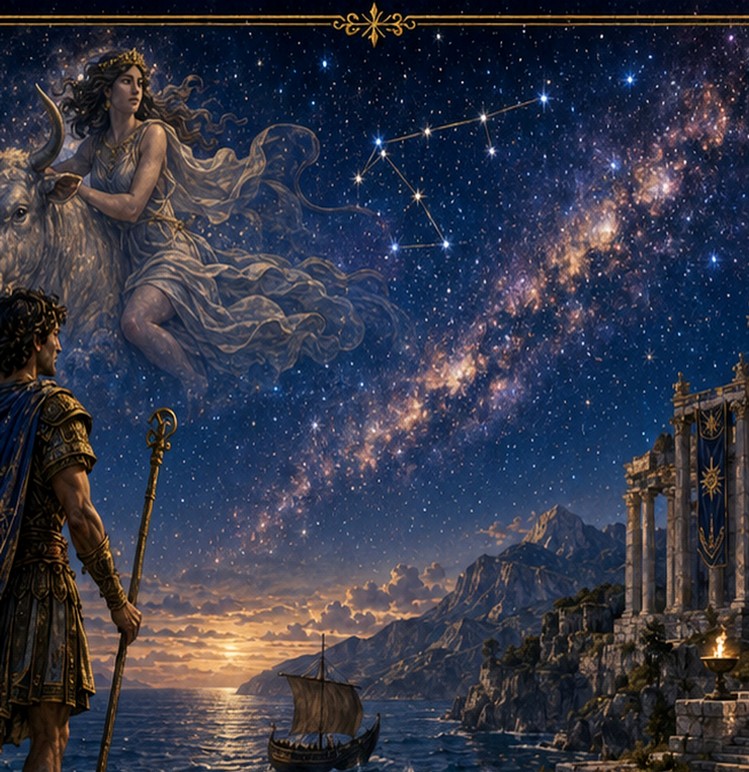
Either way, her story brings Cadmus to the island. Searching for his abducted sister Europa, Cadmus is said to have landed on Samothraki, undergone initiation into the Mysteries, and married Harmonia there. It's a lovely detail for visitors standing among the ruins of the Sanctuary today: this hillside above the sea was, in myth, a marriage ground for two of Greek mythology's great families.
The Great Gods, the Kabeiroi, and the island's true mystery
What actually happened inside the Samothracian Mysteries remains genuinely unknown — that secrecy was the point, and it held for over a thousand years. Ancient authors link the Sanctuary's Great Gods with the Kabeiroi, protective deities associated with initiation and safety at sea, but the sources don't agree on the details, and the book is careful not to force a tidy answer. What's clear is the theme: protection, secrecy, and passage — ideas that would have mattered enormously to sailors navigating the open Aegean.
From Ixion's cloud to the Golden Fleece
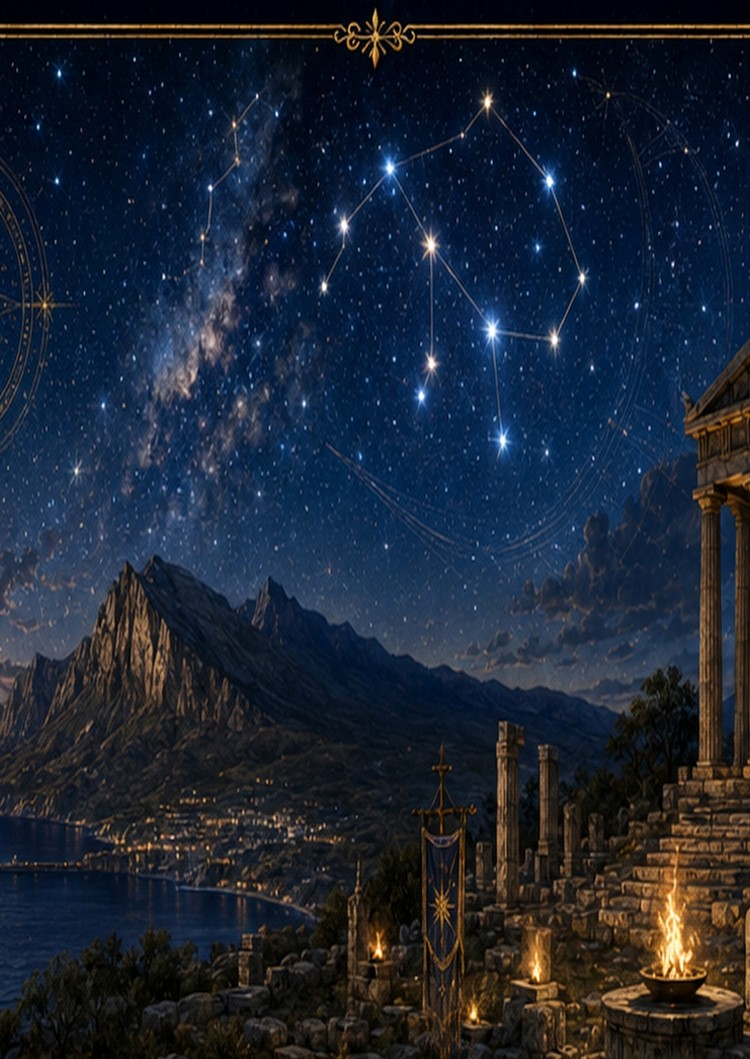
Zooming out from the island itself, the book follows a longer thread that many visitors won't expect to connect back to Samothraki at all: the story of Ixion, tricked by a cloud-double of Hera fashioned by Zeus, whose union with that phantom produces Centaurus and, eventually, the race of Centaurs. In a unified reading of the myths, that same cloud-figure, Nephele, later becomes the mother of Phrixus and Helle — whose flight on the golden ram gives the Hellespont its name and sets up the entire Argonaut cycle in search of the Golden Fleece.
It's a reminder that Greek myth rarely stays in one place. A story that starts with a Thessalian king's crime ends up, several generations later, sending Jason's ship past the very waters around Samothraki.
Zeus overhead: from myth to Jupiter's moons
Perhaps the most delightful thread for stargazers is the last one: how this genealogy quietly survives in modern astronomy. Zeus's Roman counterpart, Jupiter, lent his name to the largest planet in the solar system, and the four moons Galileo discovered in 1610 — Io, Europa, Ganymede and Callisto — are all figures from his mythic entanglements. Constellations like Hercules, Perseus and Taurus carry the same names skyward. None of this is proof of anything, as the book is careful to point out — but it shows how deeply this family of stories shaped the language we still use to describe the night sky.
Try it for yourself
You don't need a telescope to feel the connection. On a clear night, find a spot with a view of Mount Saos silhouetted against the stars, look for the tight cluster of the Pleiades, and remember that this small patch of sky was, for the people who built the Sanctuary below it, a map of kinship as much as a map of the heavens.
This article is adapted from Astromythology of Samothrace by geologist and educator Evangelos Markatselis. For more information about the book, contact the author directly at +30 697 4472485.



















.svg)